The ceiling stain near a chimney is one of those problems that announces itself in the most inconvenient way — usually at the tail end of a rainstorm, when you can't do anything about it. And the stain is never where the water actually got in. It's where the water ended up after traveling through the wall cavity from the real entry point up at the roofline.
Chimney flashing is almost always the entry point.
What Chimney Flashing Is
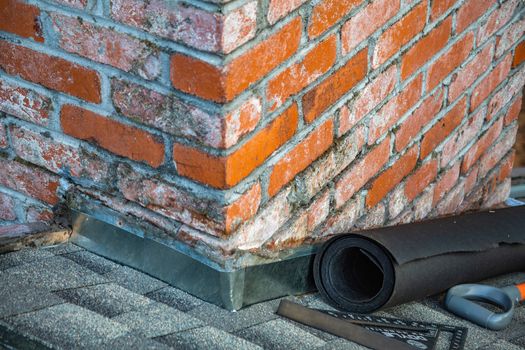
Flashing is the metal seal between the chimney and the roof surface. It consists of two types of metal that work together.
Step flashing is woven into the roof shingles along both sides of the chimney, running up the slope. Each piece overlaps the one below it, creating a layered barrier that sheds water away from the chimney-to-roof joint.
Counter flashing is embedded into the chimney mortar joints and lapped over the step flashing. It covers the top edge of the step flashing and bridges the gap between the metal and the masonry. The junction between the counter flashing and the chimney — typically sealed with caulk or mortar — is where failures most often originate.
At the high side of the chimney (where the roof slopes into the chimney face), a piece called the saddle or cricket deflects water around the chimney rather than letting it pond behind it. On chimneys wider than 30 inches, a properly installed saddle is a code requirement — and its absence is a common oversight in older installations.
Why Flashing Fails
Flashing fails for several reasons, and they often compound each other.
Sealant deterioration is the most common starting point. The caulk or mortar that seals the counter flashing to the chimney masonry cracks and shrinks over time from thermal cycling — the chimney and roof expand and contract at different rates with temperature changes, and the sealant absorbs that movement until it can't anymore. A visible crack at the flashing-to-masonry joint is a direct water entry path.
Rust and corrosion affect galvanized steel flashing over time, particularly in coastal California where salt air accelerates oxidation. Rust eventually creates gaps and holes in the flashing itself.
Improper original installation is a third cause — flashing that was never properly embedded in the mortar joint, or step flashing that was installed incorrectly relative to the shingles, eventually separates. This shows up relatively soon after installation compared to sealant or rust failures, which take years to develop.
Roofing contractors and chimney contractors don't always coordinate well on flashing. If your roof was recently replaced and you now have a chimney leak you didn't have before, improper flashing during the re-roof is the likely cause.
How to Spot a Flashing Problem
From ground level, these signs suggest flashing problems:
- ›Brown or yellow water staining on the ceiling near the chimney — particularly if it appears after rain
- ›Water staining on the wall beside the chimney — indicates water traveling down from the roofline
- ›Rust staining on the chimney exterior, tracing from the roofline downward
- ›Visible gaps between the metal flashing and the chimney masonry — sometimes visible with binoculars
- ›Peeling paint or bubbling drywall near the fireplace on upper floors
- ›A musty smell from the chimney area in wet weather
What Flashing Repair Looks Like
Minor flashing repair — sealing deteriorated sealant joints where the flashing meets the masonry — is relatively straightforward and can sometimes be done in a short service visit. The technician cleans the joint, removes deteriorated sealant, and applies a new, properly formulated elastomeric sealant that handles movement better than standard roofing caulk.
More significant repair — replacing corroded step flashing, re-embedding counter flashing that has pulled from the mortar, or installing a missing saddle — involves carefully lifting shingles and working around the chimney on the roof. It's a more involved service, but still considerably less expensive than remediating water damage inside the home.
If the underlying masonry has been saturated and damaged from long-term water entry, the flashing repair is part of a larger scope that may include tuckpointing or crown repair.
Our chimney flashing repair service covers everything from deteriorated sealant joints to full step flashing replacement — including a rooftop assessment before any work begins.
Why Early Repair Matters
Flashing leaks don't stop on their own. The water entry continues with every rain, slowly saturating the wall framing, insulation, and drywall. What starts as a straightforward sealant repair becomes a significant wall remediation project if left for several wet seasons.
In California, the rainy season runs roughly November through March in most regions. A flashing problem identified in October — before the season — is far cheaper to fix than the same problem identified in April after five months of water entry.
When to Call a Professional
If you see any of the signs above, schedule a rooftop chimney inspection. Most technicians can identify whether flashing is the source of a leak versus the crown, cap, or masonry — and they can tell you whether it's a sealant repair or a flashing replacement situation before any work starts.